
Reviewed · HISTORICAL TOURS
Private Historical Tour: The Best of Ghent
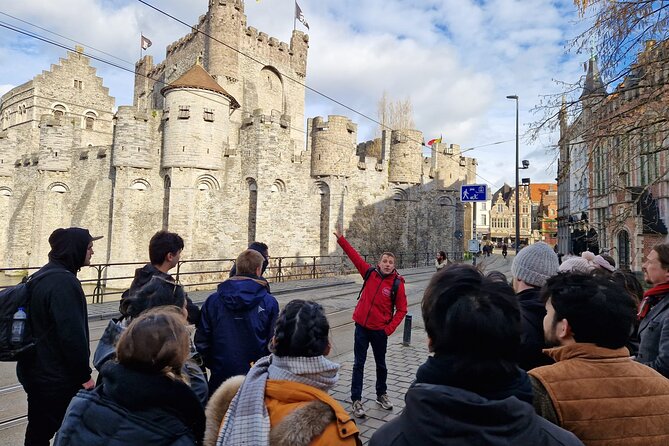
Ghent rewards a good first walk. This private tour links the city’s medieval core with its trading past, rebellious character, and memorable local legends. I like the private format, which lets you ask questions and set the pace, and I like the clear route from St. Michael’s Bridge to St. Nicholas’ Church. The main drawback is value: at $105.82 per person, you see most sights from outside, and admission tickets are not included.
You get a compact two-hour introduction led by a local guide, with all fees, taxes, and hotel pickup and drop-off listed as included. The tour is offered in English, with multilingual availability noted, but you should confirm your preferred language and pickup details before booking. A few service problems have been reported, including one no-show and one tour that ran only 80 minutes, so communication matters.
In This Review
- Key points at a glance
- Starting above Ghent’s medieval center
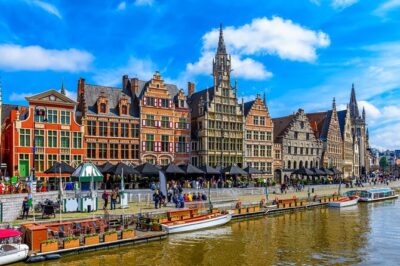
- Graslei and Korenlei, where trade shaped the city
- Great Butchers’ Hall and Ghent’s darker side
- Gravensteen, a castle in the middle of town
- St. Veerleplein, life and death beside the castle
- Huis van Alijn and the city’s former god house
- Vrijdagmarkt and the memory of resistance
- Werregarenstraat, Ghent’s sanctioned graffiti alley
- Town Hall, a building that looks confused
- St. Bavo’s Cathedral and the Van Eyck masterpiece
- The Belfry, the people’s tower
- St. Nicholas’ Church and the final legend
- What the private format is really worth
- Who should book this Ghent history walk
- Should you book Private Historical Tour: The Best of Ghent?
- FAQ
- How long does the private Ghent tour last?
- Where does the tour start?
- Where does the tour end?
- Are admission tickets included?
- Is the tour private?
- Can I cancel for a full refund?
Key points at a glance
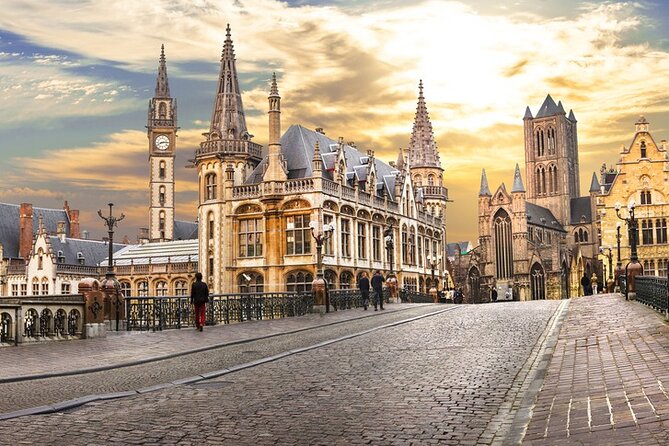
- St. Michael’s Bridge gives you Ghent’s best opening view, including the famous three-tower skyline.
- The private group setting makes questions easy, and guides such as Arn, Camila, Hans, Kenny, and Sonia have been praised for humor, local pride, and flexibility.
- The route covers major landmarks without entering them, including Gravensteen, St. Bavo’s Cathedral, the Belfry, and the Town Hall.
- Ghent’s less polished stories get plenty of attention, from the Butchers’ Hall to the former prison and the city’s graffiti alley.
- The walk ends at the Belfry, placing you near the center of Ghent for independent sightseeing afterward.
- The price pays for personal attention, not museum admission, food, drinks, or a city historical pass.
Starting above Ghent’s medieval center
The meeting point is Hostel Uppelink on Sint-Michielsplein, beside St. Michael’s Bridge. This is a smart place to begin because the bridge gives you an immediate sense of Ghent’s shape. From here, the city’s three famous towers line up in the distance: St. Nicholas’ Church, the Belfry, and St. Bavo’s Cathedral.
Your guide begins with Ghent’s role as a medieval trading center. That opening matters because it gives the rest of the walk a useful thread. The canals, grand guild buildings, squares, churches, and castle are not random decorations. They reflect a city that grew wealthy through commerce, guarded its independence, and often resisted outside control.
You spend about 15 minutes here. Admission is free, and this first stop is more about orientation than sightseeing inside a monument. If you have just arrived by train or are visiting Ghent for a single day, the view helps you get your bearings fast.
More History Tours in Ghent
- Historical Walking Tour: Legends of Gent
★ 5.0 · 1,761 reviews - Ghent: 40-Minute Historical Boat Tour of City Center
★ 4.3 · 430 reviews - Bicycle tour in historic Ghent
★ 5.0 · 87 reviews
Graslei and Korenlei, where trade shaped the city
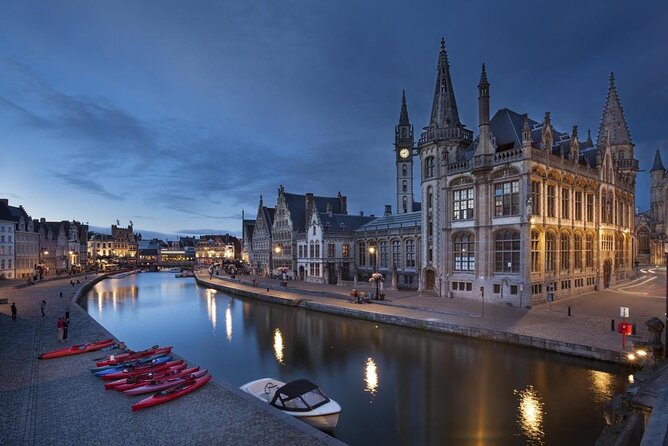
The walk continues to Graslei and Korenlei, two canal-side streets that form the visual heart of old Ghent. The setting is attractive, but the guide’s explanation of the buildings is the real reason to pause here.
You learn which structures were tied to medieval trade and how this stretch functioned as the city’s port. The tour spends about 10 minutes in this area, enough to explain the commercial life of the canal without turning the stop into a long architecture lecture.
This is one of the best places to listen carefully rather than simply take photographs. The façades are easy to admire, but the trading story explains why Ghent grew so powerful. I also like that the tour uses the buildings as evidence of the city’s past instead of treating them as a backdrop for quick snapshots.
A brief stop connected with the Design Museum adds a different angle. The guide explains how one particular feature of the museum reflects the stubborn, rebellious spirit of the Gentenaars, the people of Ghent. The supplied route gives little detail about the exact feature, so expect a short local story rather than a museum visit.
Great Butchers’ Hall and Ghent’s darker side
At Het Groot Vleeshuis, you look across the water toward the medieval covered Great Butchers’ Hall. The building is impressive, but the guide also shares darker facts about its past.
That contrast is useful. Ghent is often presented as a picturesque canal city, yet its history includes strict trade rules, harsh punishment, and less pleasant working conditions. This stop helps keep the tour from becoming a string of pretty views and cheerful legends.
You spend about 10 minutes here, again without entering. If you want detailed food history or a look inside the hall, you will need to make separate plans. The tour’s purpose is to explain the site and connect it to the wider story of medieval Ghent.
Gravensteen, a castle in the middle of town
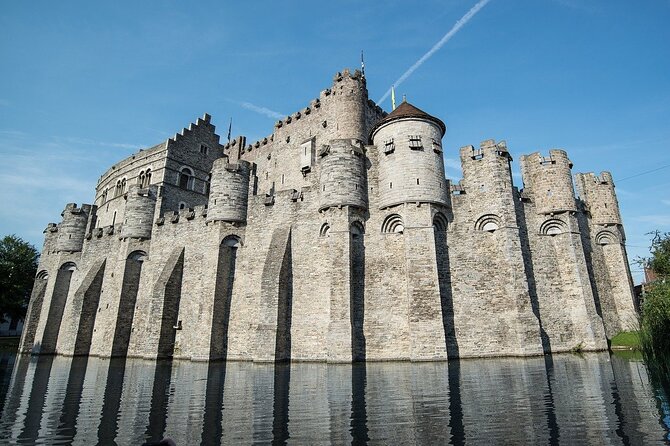
Gravensteen is one of Ghent’s most striking sights because the medieval Castle of the Counts sits right in the city center. It is also unusually well preserved, making its heavy walls and defensive form easy to understand from the outside.
The guide spends about 10 minutes explaining the castle’s past. This is a good example of the tour’s basic method: you get historical context and stories at the building itself, but you do not receive entry to explore the interior.
That distinction is important when you compare prices. Gravensteen can take much longer if you enter, and the castle has enough rooms and exhibits to justify a separate visit for anyone who wants more than an exterior view. The walking tour gives you the background first, which can help you decide where to spend your own time later.
A completely different kind of day:
- Ghent: 50-Minute Medieval Center Guided Boat Trip
★ 4.5 · 5,637 reviews - Ghent: 40 Minute Medieval Center Guided Boat Tour
★ 4.4 · 884 reviews - Evening Tour of the Dark Side of Gent
★ 5.0 · 646 reviews - Ghent Bike Tour Off-the-beaten-track
★ 5.0 · 505 reviews
St. Veerleplein, life and death beside the castle
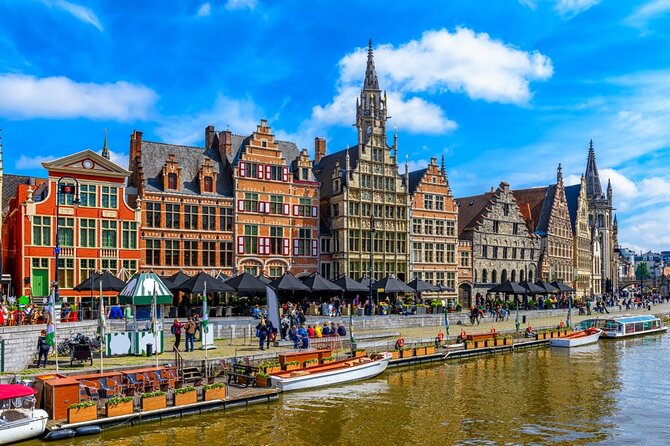
The square in front of Gravensteen is St. Veerleplein. It is known by two opposing descriptions, the square of death and the square of life. Your guide explains the reason for both names.
This is the sort of short local detail that makes a private walk worthwhile. A guide can point to the setting, explain the contrast, and answer the natural follow-up questions. You spend around 10 minutes here, and the stop adds human drama to the castle rather than treating it as a silent stone monument.
The route does not give the story away in advance, which is part of the fun. Expect a legend and historical context, not a long visit inside another attraction.
Huis van Alijn and the city’s former god house
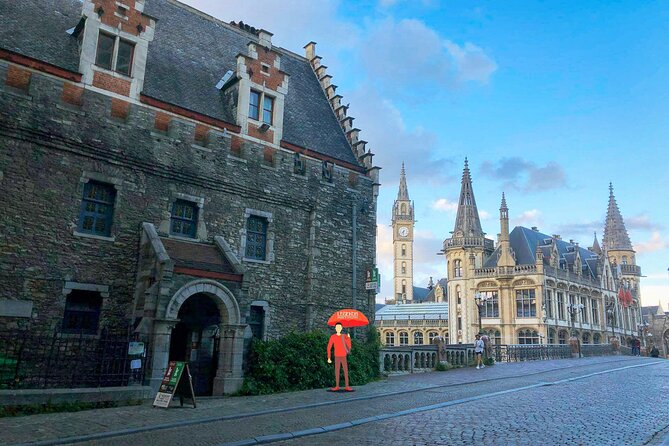
The House of Alijn occupies the only remaining god house in Ghent. The tour explains how it became a hospital and shares the unfortunate story behind that change.
This stop broadens the walk beyond rulers, merchants, and military buildings. You get a look at how ordinary people were cared for, or failed to be cared for, in earlier centuries. The name and history of the site also show how religious and civic life overlapped in medieval cities.
The visit lasts about 10 minutes and remains an exterior explanation. If the social history interests you, Huis van Alijn is a place you may want to return to independently, since this tour does not include entry.
Vrijdagmarkt and the memory of resistance
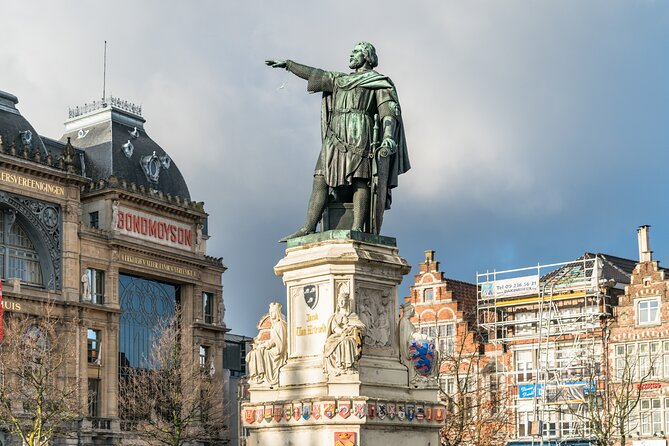
Vrijdagmarkt is one of Ghent’s historic public squares. It has played an important role in the city’s political and social life, and the statue in the middle gives the guide a natural starting point for telling that story.
You spend about 10 minutes here. The square helps explain Ghent’s long habit of defending its rights and resisting authority. That theme appears again later at the Town Hall and Belfry, so this is not an isolated anecdote. It is part of the tour’s larger portrait of a proud city that has never been especially easy to govern.
The personal style of the guide matters at this stop. Guides such as Arn have been praised for showing clear pride in Ghent, while Onur was noted for using questions and humor to keep a younger participant involved. A private group gives you more room to stop and ask why a particular person or event mattered.
Werregarenstraat, Ghent’s sanctioned graffiti alley
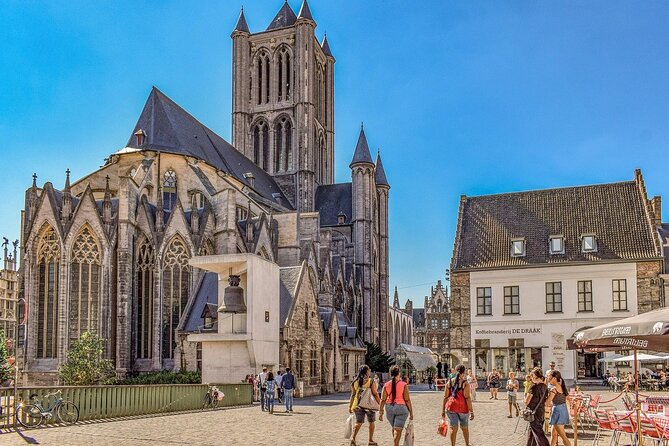
Werregarenstraat offers a sharp change of mood. To protect historic buildings from unwanted graffiti, Ghent designated this area for street artists. The guide walks you through the alley and explains its purpose.
This is one of the route’s most modern and practical stops. It shows that the city’s relationship with public space is still evolving. Medieval walls and contemporary street art share the same center, and the contrast makes the old town feel like a lived-in place rather than a preserved stage set.
Allow your guide to set the pace here. The attraction is visual and changes over time, so the value comes from seeing it in context. It is also a useful reminder that Ghent’s rebellious personality is not confined to stories from centuries ago.
Town Hall, a building that looks confused
At Ghent Town Hall, the guide explains why the building appears architecturally confused. Different sections reflect different periods and styles, tied to a major conflict in the city’s past.
You spend about five minutes here, so this is a quick explanation rather than a detailed architectural tour. Still, the stop is worthwhile because the building itself becomes a clue. Instead of asking you to memorize dates, the guide shows how political conflict can leave a mark on a city’s appearance.
This is the kind of context that makes a short tour work well. You may not remember every ruler or century, but you will understand why Ghent’s center looks the way it does.
St. Bavo’s Cathedral and the Van Eyck masterpiece
St. Bavo’s Cathedral is one of the major stops, with about 10 minutes devoted to its history and art. The cathedral is best known for the Ghent Altarpiece by Hubert and Jan van Eyck, one of Europe’s most famous works.
The guide introduces the cathedral’s past and points out the importance of the altarpiece. However, this tour does not include admission, so you should not assume you will see the artwork inside as part of the two-hour walk.
That omission is the clearest value issue for art lovers. One detailed assessment specifically pointed out that a historical pass costing 42 euros was not included. If the altarpiece, Gravensteen, or the Belfry interiors are priorities, factor those extra costs into your day.
The Belfry, the people’s tower
The Belfry of Ghent receives a short stop of about five minutes, but it carries a lot of symbolic weight. The guide presents it as the people’s tower, connected with the city’s independence, power, and stubbornness.
The former prison and its façade also provide the setting for a strange local legend. This is a strong place for storytelling because the building has both civic importance and an unusual human tale attached to it.
The tour ends in front of the Belfry on Sint-Baafsplein. That is convenient. You finish near one of Ghent’s central landmarks instead of being returned to the starting point, and you can continue to St. Bavo’s Cathedral, explore the square, or make your own way elsewhere.
St. Nicholas’ Church and the final legend
The last stop is St. Nicholas’ Church, overlooking Korenmarkt. Dating from the early 12th century, the church is dedicated to St. Nicholas, the protector of merchants and sailors.
Its location brings the tour back to the commercial world introduced at the beginning. The church’s façade also carries a legend about its patron saint, giving the walk a story-based ending rather than a simple list of monuments.
You spend about 10 minutes here. The route has now covered churches, trade, public squares, a castle, civic power, social care, street art, and local folklore. For a two-hour walk, that is a lot of ground, but the short stops mean you should expect an overview, not a detailed study of each site.
What the private format is really worth
The tour costs $105.82 per person. That is a serious price for two hours, especially because food, drinks, and entry tickets are not included. You are paying mainly for a private guide, a fixed route, personal attention, and the ability to shape the conversation.
I can see the value for a family, couple, or small group with limited time. A private guide can slow down for a person who walks carefully, adjust the order of the route, answer specific questions, and offer suggestions for the rest of your stay. Hans has been praised for adjusting the pace, and guides including Maria and Julian have offered useful restaurant advice.
The value is weaker if you mainly want inexpensive sightseeing. A small-group walk may cost less, and you can visit many exterior landmarks on your own. The private option makes the most sense when you care about conversation and historical explanation more than admission savings.
The tour has a strong overall record, with a 4.8 rating from 115 reviews and 94 percent recommendation. Praise centers on engaging storytelling, local pride, humor, and a well-organized route. Camila has been singled out for warm energy and lively anecdotes, while Sonia has been praised for putting a thousand years of history into a clear European context.
There are also real service concerns. One booking involved several start-time changes, and the walk lasted only 80 minutes instead of two hours. Another report described a guide distracted by personal phone issues. A separate booking involved a no-show and difficulty contacting the provider. These accounts are not the usual pattern, but they are serious enough that you should confirm the start time and meeting arrangement before setting out.
Who should book this Ghent history walk
I would choose this tour if you have only one day in Ghent and want a fast, sensible introduction before exploring alone. It also suits families, older relatives, and private groups who prefer to stop for questions instead of keeping up with a larger crowd.
It is a good fit for anyone who enjoys stories about political conflict, city pride, legends, and the lives of ordinary people. The route is not only about grand churches and canals. Werregarenstraat, Huis van Alijn, the Butchers’ Hall, and the two-sided story of St. Veerleplein give it more character.
I would hesitate if your main goal is entering attractions. You will need extra time and money for Gravensteen, St. Bavo’s Cathedral, the Van Eyck altarpiece, the Belfry, or Huis van Alijn. In that case, use the walk as an orientation, then reserve a separate block for interiors.
The tour is listed as accessible to most participants, near public transportation, and suitable for service animals. Since it is a walking tour through the city center, wear comfortable shoes and ask in advance about the exact hotel pickup arrangement. The listed start point is Hostel Uppelink, while hotel pickup and drop-off are also included, so that detail should be clear before the day begins.
Should you book Private Historical Tour: The Best of Ghent?
Book it if you want personal attention, local stories, and a strong two-hour framework for Ghent. The best guides turn the city into a connected story, from medieval trade to civic resistance, rather than a parade of unrelated sights.
Skip it if $105.82 feels high for an exterior-only walk or if you would rather put that money toward museum and monument admission. For the best value, schedule it early in your Ghent stay, use the guide’s food and sightseeing advice afterward, and treat the tour as your historical foundation rather than your complete visit.
FAQ
How long does the private Ghent tour last?
The tour lasts approximately two hours.
Where does the tour start?
It starts at Hostel Uppelink, Sint-Michielsplein 21, 9000 Ghent, Belgium.
Where does the tour end?
The tour ends in front of the Belfry of Ghent on Sint-Baafsplein.
Are admission tickets included?
No admission tickets to the attractions are listed as included. The tour includes all fees and taxes, but the route primarily explains the sights from outside.
Is the tour private?
Yes. Only your own group participates in the activity.
Can I cancel for a full refund?
Yes, if you cancel at least 24 hours before the experience start time. Cancellations or changes made less than 24 hours before the start are not accepted for a refund.
Just added in Ghent
- Historic Highlights, by a local guide★ 5.0 · 9 reviews
- Walking Food Tour in Ghent★ 5.0 · 13 reviews
- Discover Ghent while playing! Escape game – The alchemist★ 4.0 · 4 reviews
- Discover Ghent while playing! Escape game – The Walter case★ 4.5 · 4 reviews
- e-Scavenger hunt Ostend: Explore the city at your own pace★ 4.5 · 10 reviews
- Discover Mons while playing! Escape game – The alchemist★ 4.0 · 5 reviews
- Kortrijk Self-Guided Sherlock Holmes Murder Mystery Game★ 5.0 · 2 reviews
- Taste of Ghent: Private Chocolate Walking Tour★ 5.0 · 1 review
Historical Tours, compared.



Historical Walking Tour with Chocolate & Waffle Tasting
Read our review →
THE Storytelling Tour of Bruges | First Day Must | History & Tips
Read our review →
Historical Tour with Chocolate & Waffle Tasting
Read our review →
Historical Walking Tour: The Story of Bruges – by Legends
Read our review →
Browse the lists this tour appears in