
Reviewed · DARK HISTORY WALKS
Evening Tour of the Dark Side of Gent
Ghent’s medieval past has teeth. This evening walk mixes city history with stories of murder, torture, religious conflict, legends, and political trouble. I like the way it uses famous sights such as St. Michael’s Bridge and the Castle of the Counts, then leads you into less obvious corners of the old center.
I also like the guides’ lively approach. Kenny is repeatedly praised for his jokes, storytelling, and ability to involve the group, while Isabel, Ben, and Julian are also singled out for their energy and clear delivery. The main drawback is that the dark material can vary by guide, so one outing may feel more grisly than another. A few people also had trouble finding the meeting point or arrived after the group had left.
In This Review
- Key points to know before booking
- Why the dark side works so well in Ghent
- Starting above the city at St. Michael’s Bridge
- The old harbor at Graslei and Korenlei
- A grim legend beside the Butchers’ Hall
- The Castle of the Counts and the logic of defense
- The vanished Prince’s Court
- Rabot Sluice and the old defense wall
- Charles V and the scars of religious conflict
- Finishing in Patershol
- How much walking and how dark is it?
- Guide style and group size
- The $3.62 price and overall value
- Who should book the Dark Side of Gent?
- FAQ
- Where does the tour begin?
- Where does the tour end?
- How long does the experience last?
- What language is offered?
- How much does the tour cost?
- Is the tour available by mobile ticket?
- How many people can join the tour?
- Does the tour require a minimum number of participants?
- Is the tour canceled in poor weather?
- Can I cancel for a full refund?
- Is the tour suitable for most people?
- Should you book it?
Key points to know before booking
- Nearly two hours on foot: The tour lasts about 1 hour 45 minutes and crosses much of central Ghent at a slow, mostly level pace.
- History with a sinister edge: Expect stories about murder, torture, executions, religious wars, political power, and medieval punishment.
- Excellent nighttime scenery: St. Michael’s Bridge, the old harbor, the Castle of the Counts, and Patershol provide strong photo stops after dark.
- Strong guide-led experience: Kenny receives especially warm praise for his humor, local knowledge, and animated storytelling.
- Very low price: At $3.62 per person, the cost is remarkably small for a guided walk of this length, assuming the tour runs.
- A little practical caution: Arrive early at Hostel Uppelink, confirm the exact meeting spot, and remember that the tour needs a minimum number of participants and good weather.
Why the dark side works so well in Ghent
Ghent is often presented through its canals, guild houses, towers, and grand medieval buildings. Those sights deserve attention, but they can also make the city feel almost too polished. This tour adds the less flattering human details: punishment, greed, religious violence, social division, and rulers who were not always gentle with the people under them.
That contrast is the chief pleasure of the walk. You are not simply looking at a beautiful cathedral or an imposing castle. You are hearing why a building mattered, who controlled it, and what could happen when ordinary people crossed the wrong authority.
The tone is not a solemn lecture. The best guides use jokes and dramatic delivery, and the group is encouraged to stay engaged. Kenny is particularly praised for mixing history, myths, questions, and a morbid sense of humor. That style will suit you if you enjoy a little theatricality with your facts.
The title promises a dark tour, but it is not a nonstop parade of grisly detail. One person found the walk more like a general history tour, with less gore than expected. That is a fair warning. You get dark stories, but also urban history, architecture, public art, and an explanation of how Ghent changed over time.
More dark history walks in Ghent:
- Private Tour: The Dark Side of Gent
★ 5.0 · 73 reviews - Ghent: The Dark Side of Ghent Private Walking Tour
★ 4.9 · 19 reviews - Kortrijk Self-Guided Sherlock Holmes Murder Mystery Game
★ 5.0 · 2 reviews
Starting above the city at St. Michael’s Bridge
The tour begins at Hostel Uppelink on Sint-Michielsplein. From there, the first major stop is St. Michael’s Bridge, one of the best places to understand Ghent’s central skyline.
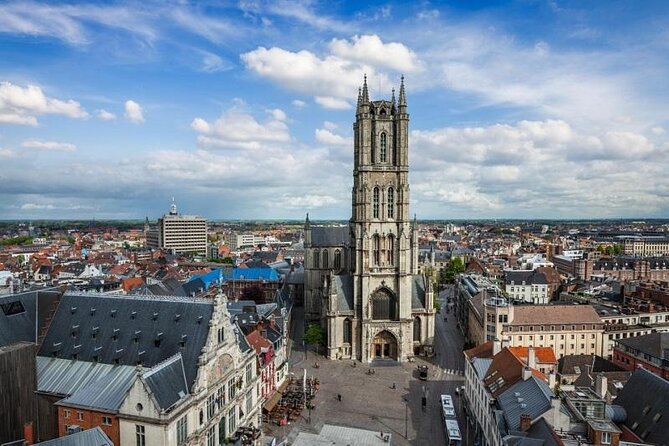
Your guide introduces Ghent as a medieval trading center and points out the city’s three famous towers. From this angle, the towers line up in a particularly useful view, making it easier to understand the shape of the old center before you start walking through it.
This opening is more than a photo stop. It gives you a quick explanation of why Ghent became important in the first place. Trade brought money, power, rivalries, and a need for defense. Those forces shaped nearly every later story on the route.
There is also a darker tale connected with the cathedral, which is sometimes called the Devil’s Tower. The guide explains the gruesome reason behind that name. The supplied information does not give away the full story, which is probably for the best. It is meant to be told in person, with the cathedral setting close at hand.
Allow a few minutes to get organized here. The meeting point has caused confusion for some people, including complaints about an incorrect address and a group leaving before the advertised start time. I would arrive at least 15 minutes early and check that you are at Hostel Uppelink, Sint-Michielsplein 21, rather than simply waiting somewhere near the bridge.
The old harbor at Graslei and Korenlei
From St. Michael’s Bridge, the route continues to Graslei and Korenlei. These waterfront quays form the heart of medieval Ghent’s harbor district, where goods moved in and out of the city and merchants made fortunes.
By day, the area is one of Ghent’s most popular scenic spots. At night, the buildings and water take on a quieter mood. The walk uses the setting to explain how profitable trade made Ghent an economic force in Europe.
This is a good example of the tour’s balance. The story is not necessarily dark in itself, but it explains the competition and wealth that sat behind the city’s beautiful façades. You begin to see that the charming old harbor was also a place of money, business deals, social rank, and pressure.
The stop is scheduled for about 10 minutes, so expect a concise explanation rather than a long architectural lecture. You will have time to look around, but the group needs to keep moving.
A grim legend beside the Butchers’ Hall
At Appelbrugparkje, the guide takes you onto a bridge overlooking the large Butchers’ Hall. This is one of the more unusual stops because it combines a specific local view with a story about an execution.
The tale concerns a father and son condemned to die and the miraculous event that saved them. It is presented as a legend, so you should listen for the difference between documented history and a story that has grown through retelling.
That distinction matters on a tour like this. Medieval cities produced both records and folklore, and the two often sit side by side. A skilled guide makes the uncertainty part of the fun rather than pretending every dramatic detail is proven.
The bridge also gives you another useful angle on the old center. Several people particularly liked being taken to smaller monuments and places they might have missed while walking around alone. Appelbrugparkje fits that promise well: it is connected to a major sight but not necessarily a place you would choose without local direction.
More things to do in Ghent:
- Ghent: 50-Minute Medieval Center Guided Boat Trip
★ 4.5 · 5,637 reviews - Historical Walking Tour: Legends of Gent
★ 5.0 · 1,761 reviews - Ghent: 40 Minute Medieval Center Guided Boat Tour
★ 4.4 · 884 reviews - Ghent Bike Tour Off-the-beaten-track
★ 5.0 · 505 reviews
The Castle of the Counts and the logic of defense
The Castle of the Counts is the route’s most obvious fortress and one of its strongest visual stops. The tour connects it with Count Baldwin, who built a defensive stronghold in the ninth century during the period of Viking raids.
The castle helps explain how Ghent developed. Protection drew people toward secure places, and the settlement around the fortification helped the city grow. Your guide uses the castle to discuss power, defense, and the uneasy relationship between rulers and the people they claimed to protect.
At night, the castle can feel especially atmospheric. Its heavy walls and towers suit the theme without needing much decoration. You do not need to enter the castle for this part of the tour, since the stop is an outdoor explanation and the admission ticket is free.
Expect about 10 minutes here. That is enough for the central story, but not enough for a full visit to the castle interior. If you want to explore the fortress in detail, plan a separate visit during opening hours.
The vanished Prince’s Court
The route then turns toward what was once the Prince’s Court, a huge palace that is now difficult to picture in full. The building’s disappearance makes this stop different from the castle and cathedral.
Here, imagination becomes part of the experience. Your guide reconstructs a place that no longer dominates the city, showing how urban power can fade even when its former importance was enormous.
This is also where the storytelling format pays off. A plaque alone may tell you that a palace once existed. A guide can explain what that meant for Ghent’s rulers, how the site fit into the city, and why so little of the original presence remains.
Do not expect a grand surviving palace complex. The value lies in learning to read absence. Ghent’s past is not limited to what remains intact.
Rabot Sluice and the old defense wall
At Rabot Sluice, the guide points out the only remaining tower from a medieval defense wall that once stretched for 14 kilometers around Ghent.
This is a useful reminder that medieval security was not only about a castle. Entire cities needed walls, gates, towers, and controlled access. The surviving tower gives you a physical clue to the scale of the lost defenses.
The stop is about 10 minutes, and the walk to reach it helps move you away from the most heavily visited streets. That change is one of the tour’s strongest features. You get a broader sense of Ghent instead of spending the full evening around the postcard views.
The route covers substantial ground, so wear comfortable shoes. One comment specifically warns that there is a lot of walking. Another describes the pace as slow and mostly level, which makes the distance manageable for many people, but it is still a walking tour rather than a short loop around one square.
Charles V and the scars of religious conflict
The stop called Keizer Karel takes you to the Bridge of Imperial Delights. Four sculptures there depict legendary scenes from the life of Charles V, and the guide explains some of them.
This is an enjoyable stop for anyone who likes small public artworks with a story behind them. The sculptures are easy to pass without understanding, but the guide gives you a reason to look closely and connects them with Charles V and Ghent’s political past.
The walk then turns to the Religious Wars and the effect of Calvinist rule on the city. This section adds serious political and religious context to the evening. Ghent’s conflicts were not just private disputes or isolated acts of cruelty. Changes in belief and government affected public life, buildings, authority, and the city’s future.
The material can be heavy, but the guides generally keep it moving with humor. If you want a strictly academic account of religious reform, this is not the right format. If you want a clear introduction with memorable stories and visible sites, it works well.
Finishing in Patershol
The final stop is Patershol, the medieval quarter whose name means Monk’s Hole. Its narrow streets and old character make it a fitting place to finish a tour about Ghent’s less polished past.
The closing story shifts from medieval crime and religious struggle to the Industrial Revolution. Your guide explains the social effects of industrialization and how it helped shape the city’s economic revival.
That ending gives the walk a useful arc. You begin with medieval trade and defense, pass through rulers and religious conflict, and finish with the economic and social changes that helped modern Ghent develop.
The tour ends in the city center, close to bars and restaurants. That is practical after an evening walk. You can stop for a drink or dinner without needing another long trip across town.
How much walking and how dark is it?
Plan on about 1 hour 45 minutes, with stops generally lasting around 10 minutes. The route includes many parts of central Ghent, and the pace is described as slow and mostly level.
Comfortable shoes matter more than special hiking gear. The walk is not presented as physically demanding, but you will cover enough ground for poor footwear to become annoying.
The tone is suitable for many families, and one account specifically describes children enjoying it. Still, the subject includes murder, torture, executions, bloodshed, and medieval punishment. You know your group best. Young children who dislike frightening stories may not enjoy the darker sections.
The word dark also refers to the evening setting. Some people loved seeing Ghent at night and stopping for photos. Bring a charged phone, especially if you want pictures at St. Michael’s Bridge, Graslei and Korenlei, or the castle.
Guide style and group size
The guide makes or breaks this experience. The route has strong ingredients, but the stories need timing, humor, and clear explanations.
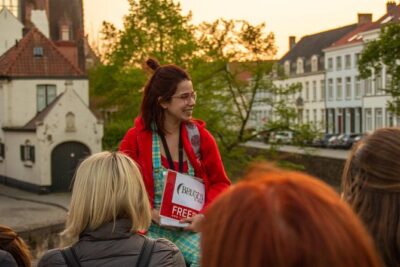
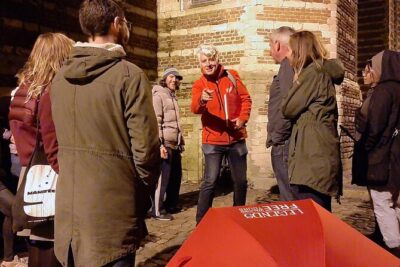
Kenny receives the most enthusiastic praise. He is described as funny, animated, personable, and especially good at combining jokes with detailed history. Isabel is praised for enthusiasm and excitement, while Ben and Julian are also described as engaging guides. The best moments seem to come when the guide involves the group rather than simply reciting dates.
The maximum group size is 35 people. That is large enough to create energy but small enough for a walking guide to manage in most situations. A larger group can make it harder to hear, so staying near the guide is sensible.
The exact content may vary. One person felt the tour did not deliver enough dark material, noting that the guide’s choices affect the balance. I would book this if you want history with a sinister flavor, not if you require a carefully fixed list of shocking stories.
The $3.62 price and overall value
At $3.62 per person, this is unusually inexpensive for a guided walk lasting nearly two hours. All fees and taxes are included, and there is no separate admission charge for the stops described.
The value comes from the guide, not from paid entry. You are paying very little for a structured route, local stories, nighttime views, and explanations that can help you notice details you might otherwise miss.
The low price also comes with a practical risk. The tour requires a minimum number of participants, and it can be canceled if that number is not reached. Some people reported arriving for a tour that did not proceed because the minimum was not met. If the operator cancels for that reason, you are offered another date or experience, or a full refund.
The same applies to poor weather. Free cancellation is available up to 24 hours before the start time. Changes or cancellations made less than 24 hours ahead are not accepted for a refund.
Who should book the Dark Side of Gent?
I would choose this walk if you want a quick introduction to Ghent that goes beyond the main façades. It is especially good for first-time visitors who want to get oriented, see the center at night, and learn why certain buildings and sculptures matter.
It also suits you if you enjoy legends, grim medieval stories, and guides who tell history with a wink. The combination of real events and folklore gives the tour its character.
I would hesitate if you dislike horror themes, need guaranteed operation for a tightly planned evening, or want a fixed script with equal amounts of gore at every stop. The route is outdoors, the group needs to reach a minimum size, and the tone depends heavily on the guide.
FAQ
Where does the tour begin?
The tour begins at Hostel Uppelink, Sint-Michielsplein 21, 9000 Gent, Belgium.
Where does the tour end?
It ends in the Patershol area of central Ghent, close to bars and restaurants.
How long does the experience last?
The walk lasts approximately 1 hour 45 minutes.
What language is offered?
The tour is offered in English.
How much does the tour cost?
The listed price is $3.62 per person, with all fees and taxes included.
Is the tour available by mobile ticket?
Yes, a mobile ticket is offered.
How many people can join the tour?
The maximum group size is 35 people.
Does the tour require a minimum number of participants?
Yes. If the minimum is not met, the tour may be canceled and you will be offered another date or experience, or a full refund.
Is the tour canceled in poor weather?
The experience requires good weather. If it is canceled because of poor weather, you are offered another date or a full refund.
Can I cancel for a full refund?
Yes. You can cancel at least 24 hours before the start time for a full refund. Cancellations or changes made less than 24 hours before the start time are not accepted for a refund.
Is the tour suitable for most people?
Most people can participate, and the route is near public transportation. Service animals are allowed. The walk is mostly level but covers a lot of ground, so comfortable shoes are a good idea.
Should you book it?
Yes, if you want Ghent with its halo removed. For a very small price, you get a long evening walk through famous sights, overlooked corners, medieval legends, political conflict, and some genuinely grim stories.
Arrive early, confirm the meeting point, wear good shoes, and keep your expectations flexible about how gruesome the evening will be. If Kenny is leading, you can expect especially lively storytelling, but the route has enough variety to work with other guides as well. For a first night in Ghent, this is a smart way to see the city after the daylight crowds thin out.
Just added in Ghent
- Historic Highlights, by a local guide★ 5.0 · 9 reviews
- Walking Food Tour in Ghent★ 5.0 · 13 reviews
- Discover Ghent while playing! Escape game – The alchemist★ 4.0 · 4 reviews
- Discover Ghent while playing! Escape game – The Walter case★ 4.5 · 4 reviews
- e-Scavenger hunt Ostend: Explore the city at your own pace★ 4.5 · 10 reviews
- Discover Mons while playing! Escape game – The alchemist★ 4.0 · 5 reviews
- Kortrijk Self-Guided Sherlock Holmes Murder Mystery Game★ 5.0 · 2 reviews
- Taste of Ghent: Private Chocolate Walking Tour★ 5.0 · 1 review
Dark History Walks, compared.

Bruges at Night: Murder, Mystery & Dark Stories Small Group Walk
Read our review →
Browse the lists this tour appears in