
Reviewed · HISTORICAL TOURS
Tour of Historical Bruges knowing The Jerusalem Chapel
Bruges reveals its secrets on foot. This Spanish-only walking tour links the city’s old trading port, medieval markets, lace traditions, knightly brotherhoods, and the remarkable Jerusalem Chapel. I especially like the included entry to the Adornes estate and Jerusalem Chapel, since many city walks only show Bruges from the street. I also like the route’s unusual focus on commerce and daily life, not just the postcard canals. The main point to consider is simple: if you do not understand Spanish, this is not the right tour for you.
The tour lasts about two and a half hours and costs $28.94 per person. That is fair value if you want a guide to explain the stories behind Bruges and admission to the Jerusalem Chapel, the Adornes domain, the almshouses, and the Scottish Hall. You will walk about 2.5 hours, finish far from the Markt at the windmills, and see several buildings only from the outside.
In This Review
- Key points to know before booking
- Why this Bruges walk feels different
- Starting at Historium and the old port
- Ter Beurze and the birth of the stock market
- Food, religion, and the streets of Sint-Jansplein
- Canals, the oldest bar, and Sint-Anna
- The Adornes estate and Jerusalem Chapel
- Lace, folklore, and old city walls
- Finishing beside the medieval windmills
- What the $28.94 price really covers
- Who should book this Bruges experience
- Should you book the Jerusalem Chapel tour?
- FAQ
- Is the tour conducted in Spanish?
- How long does the tour last?
- What time does the tour begin?
- Where does the tour begin?
- Where does the tour end?
- Is admission to the Jerusalem Chapel included?
- Are the almshouses included?
- Is the drink in the Scottish Hall included?
- Does the tour enter the museums and medieval mills?
- What is the cancellation policy?
Key points to know before booking
- Spanish throughout: The guide conducts the entire experience in Spanish, with no alternate language option stated.
- Jerusalem Chapel included: You enter the unusual chapel modeled on the Holy Sepulcher in Jerusalem.
- A trade-focused Bruges walk: The route explains the old port, the Ter Beurze family, merchant lodges, customs, and medieval commerce.
- Small-to-medium group size: The maximum is 25 people, which should make it easier to hear the guide than on a large city tour.
- A one-way route: You begin at Markt and finish at Sint-Janshuismolen beside the canal and mills.
- Afternoon timing: The tour starts at 2:30 p.m. and runs for approximately 150 minutes.
Why this Bruges walk feels different
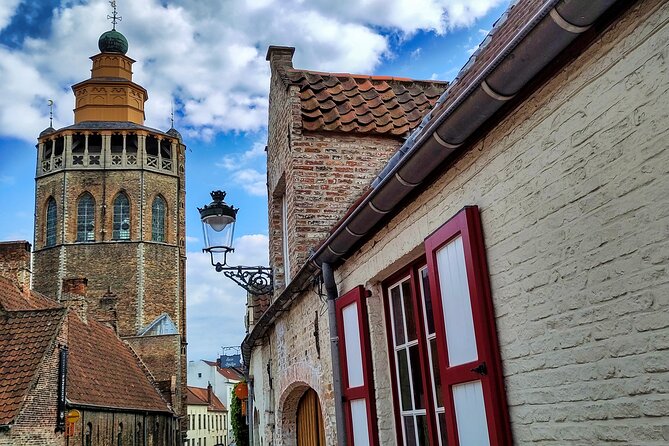
Bruges has no shortage of tours. Many stay around the Markt, Burg Square, the canals, and the most photographed lanes. This experience takes a different path. It begins in the old commercial quarter and gradually moves toward Sint-Anna, the Adornes estate, the lace district, and the eastern edge of the city.
That route gives you a more complete sense of how Bruges worked. You hear about ships being loaded, merchants arriving from abroad, porters moving goods, customs officials collecting duties, and craftsmen making lace. The city becomes more than a pretty medieval backdrop. It becomes a working place shaped by money, trade, faith, and competition.
I also like the tour’s storytelling approach. The guide connects streets and buildings to people, families, guilds, and religious groups. The result is closer to walking through a narrated story than checking off monuments. Two published comments praised precisely this quality, describing the experience as a story with a narrator and highlighting the guide’s explanations of small details at each corner.
The tour is only offered in Spanish, so language matters more here than on many Bruges walks. If you speak Spanish comfortably, that restriction becomes an advantage because the guide can keep the group focused without switching between languages.
More History Tours in Bruges
- Historical Walking Tour: Legends of Bruges
★ 5.0 · 2,541 reviews - THE Storytelling Tour of Bruges | First Day Must | History & Tips
★ 5.0 · 925 reviews - Historical Walking Tour: The Story of Bruges – by Legends
★ 4.7 · 483 reviews
Starting at Historium and the old port
You meet at the Infokantoor Markt at Markt 1, then begin in the courtyard of Historium Brugge. You do not enter the museum. Instead, the courtyard provides a starting point for the story of Bruges and its former commercial port.
This is a useful opening because it places the city’s fame in an economic setting. Before Bruges became a destination for canals and medieval facades, it was a port city connected to merchants and ships. The guide uses this first stop to explain how Bruges began to grow and why trade shaped its streets.
The opening stop lasts about 15 minutes, so it should not feel like a long lecture before the walking begins. From there, you continue to Kraanplein, where the discussion turns to the practical business of loading and unloading ships. The stop lasts only about seven minutes, but it adds an important question: how did goods actually move through medieval Bruges?
You will see the places where commercial activity once took place, but do not expect a working harbor or a museum display. The value comes from the explanation and the setting.
Ter Beurze and the birth of the stock market
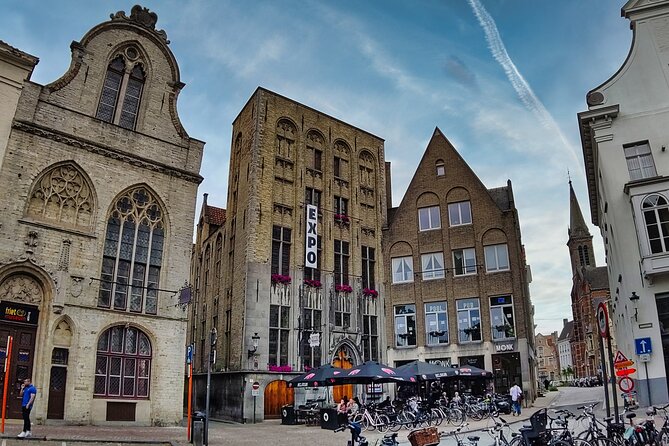
At Huis Ter Beurze, the guide introduces the Ter Beurze family and explains how its name became linked to one of the world’s best-known financial terms. You see the facade from outside, and admission is not included.
This is one of the tour’s best historical connections. The word stock market can feel modern and abstract, but here it is tied to a particular family and a particular place in Bruges. The stop is brief, around seven minutes, yet it helps explain why the city was once known as a major center of international commerce.
You then reach Jan Van Eyckplein, a larger stop lasting about 17 minutes. The square and its surroundings bring together merchant lodges, a former customs house, the porters’ house, and a brotherhood connected with knightly contests. You also see the statue of Jan van Eyck and views along the canal known as Little Venice.
This is where the tour’s mix of social history and architecture works especially well. You are not just looking at handsome buildings. You are learning who used them and what role they played. The route also asks what Anselmo Adornes meant when he described Bruges as a University of Commerce, a phrase that captures the city’s role as a place where business practices, languages, and people met.
Food, religion, and the streets of Sint-Jansplein
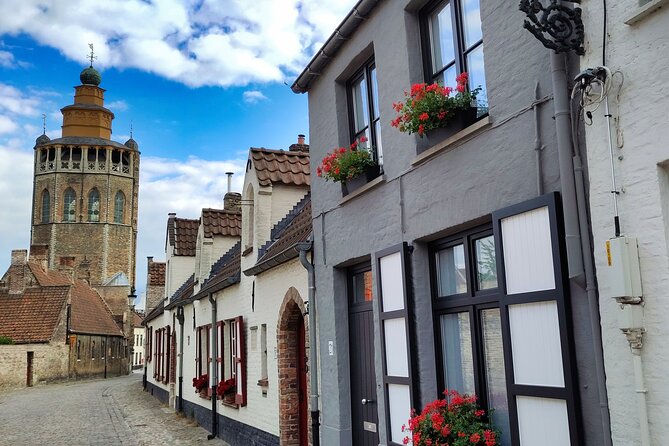
The walk continues to Sint-Jansplein, where the guide presents two food-related curiosities from Bruges. One is widely known, while the other is less familiar. The stop lasts about seven minutes.
The information provided does not specify the two subjects in advance, which can be part of the fun. If you like local food history but do not want a full tasting tour, this short section adds flavor without turning the experience into a meal-focused outing. No drinks or food are included in the tour price.
At St. Walburga’s Church, you spend about 13 minutes with one of Bruges’ clearest examples of Baroque architecture. The guide links the church to Philip the Good and to two orders he created. This stop shifts the focus from commerce to power, religion, and ceremony.
You will not enter the church according to the tour details, so the attraction here is the exterior and the explanation. That may disappoint anyone expecting an interior visit, but the church gives the route visual variety after several port and market-related stops.
A completely different kind of day:
- Bruges: Small Group Boat Cruise and Guided Walking Tour
★ 4.8 · 4,102 reviews - Bruges: Walking Tour, Canal Boat Trip w/Beer Tasting Option
★ 4.4 · 2,759 reviews - Bruges: Choco-Story Chocolate Museum Guided Tour w/Tastings
★ 4.2 · 1,379 reviews - From Bruges: Great War Flanders Fields Minibus Tour w/ Lunch
★ 4.9 · 1,257 reviews
Canals, the oldest bar, and Sint-Anna
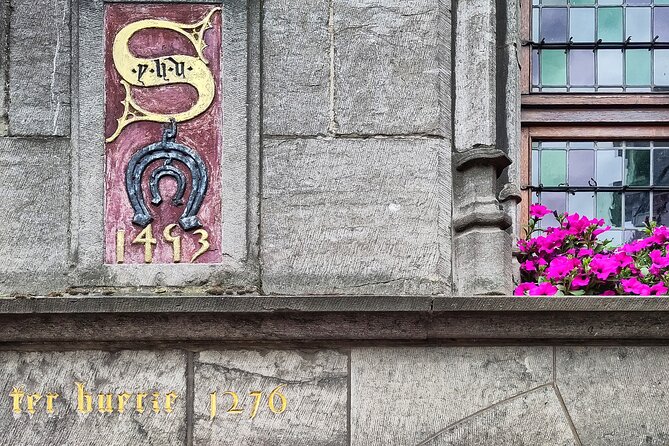
At Spinolarei, the route follows the Spínola dock and crosses or views some of Bruges’ oldest bridges. The stop lasts about 12 minutes. This is a good place to slow down and enjoy the city’s canals, particularly if you appreciate views that are less tied to the central tourist circuit.
The walk then passes the oldest bar in Bruges on the way into the Sint-Anna neighborhood. The bar is a passing point rather than a scheduled tasting stop, so you should not count on having time for a drink there. Still, it fits the tour’s interest in everyday places and old commercial life.
At Sint-Anna Church, you see a 17th-century church in the center of the neighborhood. The formal stop lasts about seven minutes. The guide also talks about the women who made bobbin lace, and if you are lucky, you may still see some lace-makers working nearby.
That detail gives the neighborhood a human scale. The lace tradition was not simply a decorative art sold to visitors. It was connected to women sitting in the streets and producing goods by hand. The experience later passes the Bobbin Lace Museum, so the subject returns in a more direct way.
The Adornes estate and Jerusalem Chapel
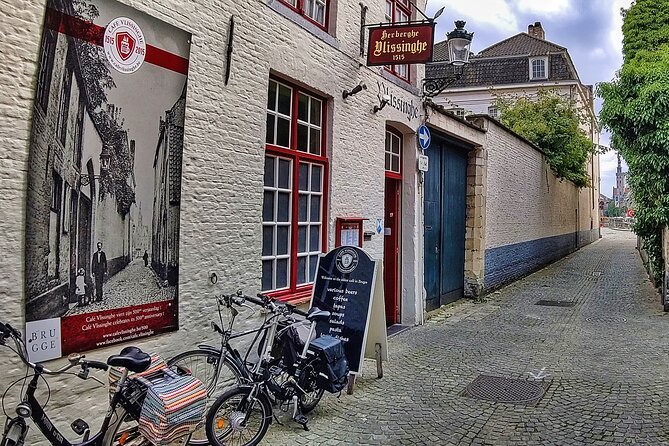
The high point comes at the Adornes estate, where you enter the Jerusalem Chapel and related parts of the domain. About 30 minutes are set aside here, making it the longest stop and the clearest reason to choose this tour over a standard city walk.
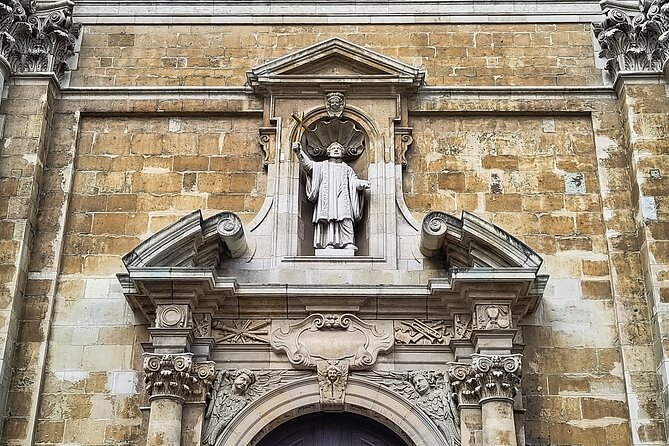
The Adornes family was among the most influential families of the late Middle Ages. Their estate includes the Jerusalem Chapel, built as a replica of the Holy Sepulcher in Jerusalem. This is not a typical Bruges church visit. Its unusual design and private family setting make it one of the city’s more distinctive religious sites.
Admission includes:
- The Adornes domain
- The Jerusalem Chapel
- The almshouses, now the Museum of the Ornaments
- The Scottish Hall
The almshouses add another layer to the visit. They show how a wealthy family’s legacy was linked not only to faith and status but also to charitable care. The Scottish Hall provides a short rest inside the domain, and a drink there is optional but not included. Soda, coffee, and tea cost extra if you choose to buy them.
I would pay close attention during this part of the tour. The chapel is the feature most likely to stay with you, but the family story and the adjoining buildings explain why this private corner of Bruges matters. You get access to a place that is easy to miss if you only follow the main squares and canals.
Lace, folklore, and old city walls
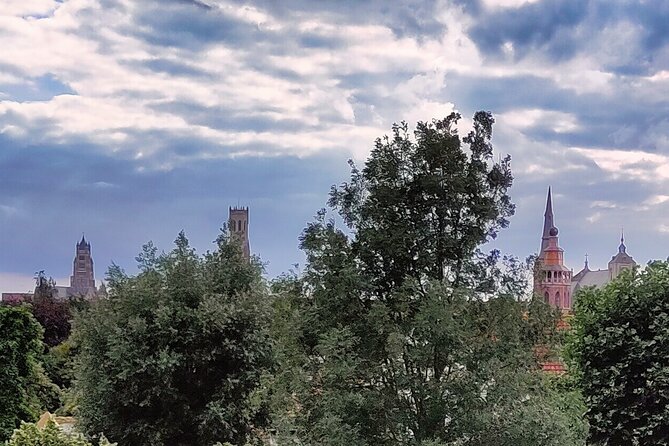
After the Adornes estate, the route follows Rolweg for about seven minutes. You pass the Bobbin Lace Museum and the Folklore Museum while walking around original 15th-century walls connected with the domain.
The museums are not part of the tour admission, so this is an exterior visit. Still, the location helps tie together several earlier themes: women’s work, local customs, and the physical limits of medieval Bruges.
You also pass the facade of the Gezelle Museum. The guide explains who Guido Gezelle was and why his house museum is located within the Adornes domain. Entry is not included. This is another short outside stop, useful if you like literary and cultural connections but less satisfying if you hoped to tour the museum itself.
At the St. Sebastian’s Guild, you see the towers from outside. This was a crossbowmen’s guild, and the tour points out that the Queen of England belonged to it until her death. The stop gives you a glimpse of Bruges’ old social clubs and military traditions, though again, you do not go inside.
These brief stops work best for people who prefer variety. You move from chapel to lace, from literature to guild life, without spending too long in any single place. If you want extended museum visits, this route will feel too fast.
Finishing beside the medieval windmills
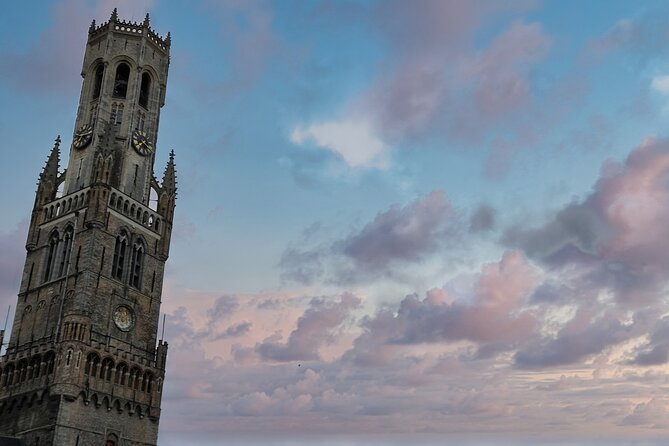
The walk ends at Sint-Janshuismolen on Kruisvest 3, beside the canal and the medieval mills. The final stop lasts about 13 minutes, and the tour does not enter the mills.
That ending is well chosen. The mills were major economic drivers of Bruges, and their position beside the water gives you some of the city’s most peaceful views. After the dense streets and close-set buildings of the historic center, the open canal setting feels like a quiet release.
You should plan your next activity from this eastern part of Bruges, not from the Markt. The tour is one-way, so you will need to make your own way back or continue exploring from the mills. The details confirm that the area is near public transportation, which helps, but no specific return route is provided.
Seeing the mills only from outside may be a drawback for anyone fascinated by machinery. The tour itself acknowledges that the interiors are worth seeing, but admission is not included. Treat this final stop as a view and photo opportunity rather than a mill museum visit.
What the $28.94 price really covers
At $28.94 per person, the price is reasonable for a 2.5-hour guided walk with admission to the Jerusalem Chapel and Adornes domain. The included entry is important because the chapel is the tour’s main special feature, and a standard free walking tour would not necessarily provide access.
You are also paying for interpretation. The route includes many short stops, and the guide’s job is to connect them into one story about trade, religion, crafts, and civic life. The strongest praise for this experience centers on the guide’s narration and the way each corner receives context.
The price does not cover food, drinks, coffee, tea, the museums along the route, or entry into the windmills. It also does not include a return to the Markt. I would view the cost as good value if you want depth and access, but less appealing if you plan to spend the afternoon inside museums or prefer a short highlights walk.
The maximum group size is 25 people. That is not a private tour, but it is more manageable than a large coach group. A mobile ticket is provided, and confirmation arrives when you book.
Who should book this Bruges experience
I would recommend this tour to you if you:
- Speak Spanish and want the full tour in that language
- Have already seen the Markt and main canals and want a different route
- Care about trade, guilds, religious history, lace, and local customs
- Want entry to the Jerusalem Chapel and Adornes estate
- Enjoy a guide who tells stories rather than simply naming buildings
- Are comfortable walking for two and a half hours
- Do not mind seeing several museums and guild buildings only from outside
I would choose another experience if you want a tour in English or another language, need frequent seated breaks, or mainly want the city’s most famous central sights. The schedule has many short stops, but the total walking time is still substantial.
The tour is suitable for most participants, and service animals are allowed. The meeting point is near public transportation. Free cancellation is available up to 24 hours before the 2:30 p.m. start time. Changes or cancellations made later are not accepted for a refund.
Should you book the Jerusalem Chapel tour?
Book it if you want Bruges explained through its working life, not just admired for its canals. The Jerusalem Chapel and Adornes estate admission gives the experience a clear advantage, while the guide’s story-led approach brings meaning to places you could otherwise pass without noticing.
Skip it if you do not speak Spanish, want substantial time inside museums, or need to finish back in the Markt area. For Spanish-speaking visitors who enjoy unusual sites and a thoughtful walking route, this is a strong choice at $28.94.
FAQ
Is the tour conducted in Spanish?
Yes. A specialized Spanish-speaking guide leads the entire tour in Spanish.
How long does the tour last?
The tour lasts approximately two hours and 30 minutes.
What time does the tour begin?
The tour starts at 2:30 p.m.
Where does the tour begin?
The meeting point is Infokantoor Markt, Markt 1, 8000 Brugge, Belgium.
Where does the tour end?
The tour ends at Sint-Janshuismolen, Kruisvest 3, beside the canal and the mills.
Is admission to the Jerusalem Chapel included?
Yes. Entry to the Jerusalem Chapel and Adornes Domain is included in the tour price.
Are the almshouses included?
Yes. Entry to the almshouses, now the Museum of the Ornaments, is included.
Is the drink in the Scottish Hall included?
No. A drink in the Scottish Hall is optional and costs extra. Soda, coffee, and tea are not included.
Does the tour enter the museums and medieval mills?
The tour passes the Bobbin Lace Museum, Folklore Museum, and Gezelle Museum but does not include their admission. It also does not enter the medieval mills.
What is the cancellation policy?
You can cancel for a full refund up to 24 hours before the experience start time. Cancellations or changes made less than 24 hours before the start are not accepted for a refund.
Just added in Bruges
- Unknown Bruges: A Self-Guided Audio Tour to the Heart of the Medieval Metropole★ 5.0 · 1 review
- Ticket Expo Body Worlds in Bruges, Belgium★ 4.5 · 11 reviews
- 2-Hour Private Walking Tour of Bruges★ 5.0 · 13 reviews
- 6 Hour Bruges Shore Excursion from Zeebrugge Cruise Port★ 4.5 · 23 reviews
- The Waffles ‘n Coffee Breakfast in Bruges Centre★ 4.5 · 9 reviews
- Explore the Instaworthy Spots of Bruges with a Local★ 5.0 · 3 reviews
- Australian Battlefields Private Tour in Flanders from Bruges★ 5.0 · 15 reviews
- Surprise Walk of Bruges with a Local★ 5.0 · 1 review
Historical Tours, compared.
Historical Walking Tour with Chocolate & Waffle Tasting
Read our review →
THE Storytelling Tour of Bruges | First Day Must | History & Tips
Read our review →
Historical Tour with Chocolate & Waffle Tasting
Read our review →
Historical Walking Tour: The Story of Bruges – by Legends
Read our review →
Browse the lists this tour appears in